Are We Really Losing a Generation?
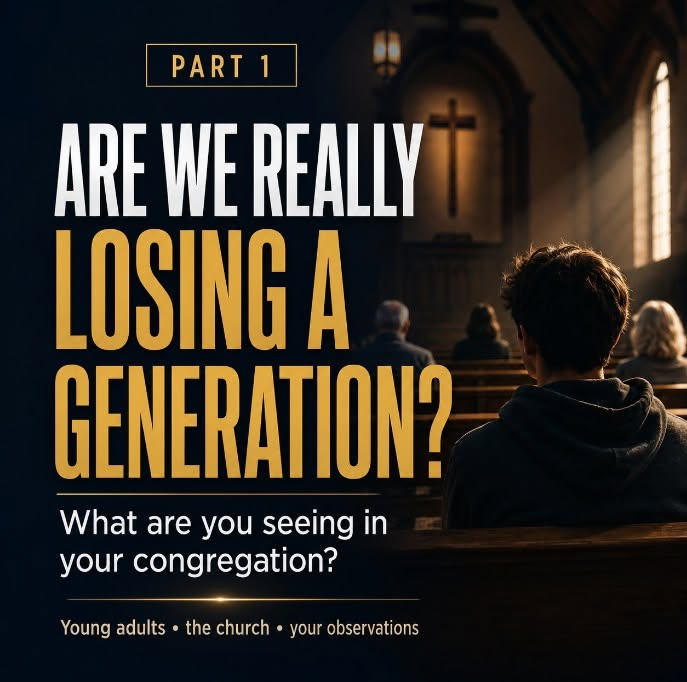
We have all heard the statement: "The church has lost the next generation." It sounds believable, especially when we look around some congregations and see very few young adults. But is it something we can actually prove, or have we repeated it so often that it now feels like an established statistic?
There are reasons for concern. Pew Research Center reports that the percentage of American adults identifying as Christian declined from 78% in 2007 to 62% in its 2023–2024 study. At the same time, Pew found that the decline has slowed considerably in recent years and may have temporarily leveled off. That means the broader religious picture is serious, but it is not quite as simple as saying that every number continues to collapse in the same direction.
The situation among churches of Christ is even more difficult to measure. The 2018 national directory listed 11,965 congregations and approximately 1.45 million adherents, reflecting a continuing decline from earlier directories. However, that information is now several years old, participation in the directory was voluntary, and autonomous congregations do not report to any central headquarters. We have evidence of decline, but we do not have a complete, current national count — and we certainly do not have enough precise information to declare that an entire generation has been lost.
I have recently been working with Dale Jenkins and Dr. Michael Jackson on an upcoming podcast that will examine statistics and trends within the Lord's church. It will begin launching soon, and one of the lessons already becoming clear is that we need to distinguish between what we know, what we think we know, and what we are merely observing in our own circles.
What Are You Seeing?
What are you seeing in your congregation? Do you have a strong group of adults between approximately 18 and 35, or is that age range noticeably absent? Are those who grew up in the congregation remaining faithful locally, attending somewhere else, moving away, attending inconsistently, or leaving the faith entirely? Are young adults who were not raised in the church being reached and converted? Is your congregation growing younger, growing older, or remaining fairly balanced?
I would especially like to hear from congregations that seem to be doing this well. What are you doing that appears to be working? Are young people being personally discipled? Are they forming meaningful relationships with older Christians? Are they being trusted with real service and responsibility? Are families studying and praying together at home? Are difficult questions being addressed honestly?
Please include a little context with your answer — your general region, the approximate size of the congregation, and what you have personally observed. There is no need to identify the congregation if you would rather not. I am not looking for slogans, guesses, or criticism of "young people today." I am looking for honest observations that might help us better understand what is actually happening.
Perhaps we have lost many young adults. Perhaps some have simply relocated or become difficult to count or have begun attending a congregation nearby. Perhaps certain congregations are struggling while others are quietly succeeding. The truth may be more complicated than the familiar headline.
What are you actually seeing where you worship?
Next, I want to examine what churches and Christian families may be doing differently in places where young adults are remaining faithful, involved, and committed to Christ.