What Helps Faith Last?
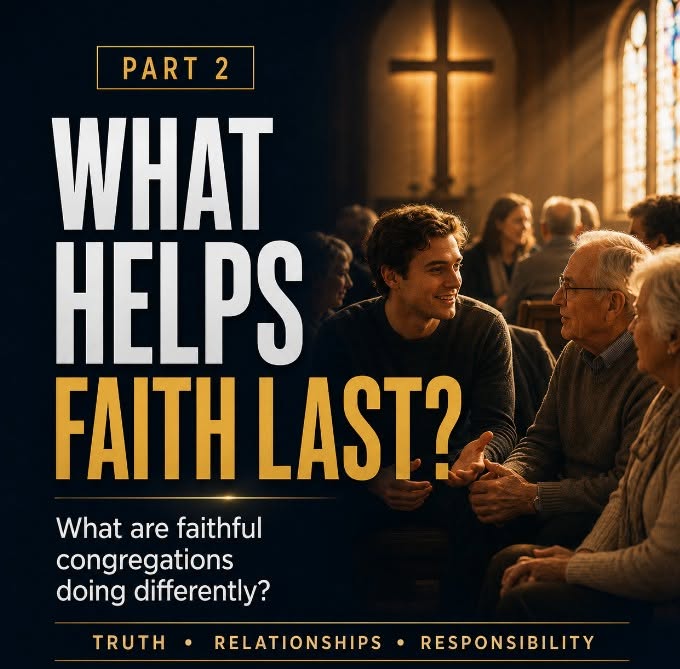
Earlier I asked whether we're really "losing a generation" or whether the situation is more complicated than that familiar statement makes it sound. The numbers give us reasons to be concerned, but they don't tell us everything. Some congregations are struggling to keep young adults connected, while others seem to be doing a much better job helping young Christians remain faithful, serve, and build their lives around Christ.
That brings us to the better question:
What are faithful congregations and Christian families doing differently?
I don't believe there's one program, one event, or one ministry model that fixes everything. Young adults aren't a problem that can be solved with better branding, louder activities, or a fuller calendar. Faith that lasts is usually built over time through truth, relationships, responsibility, example, and repeated opportunities to live out what's been taught.
Attendance Is Not the Same as Discipleship
One of the biggest differences may be the gap between church attendance and actual discipleship. A young person can sit through hundreds of Bible classes, attend every youth event, and still reach adulthood without knowing how to study Scripture on their own, pray through difficulty, explain what they believe, resist temptation, or make decisions from a Christian worldview.
Attendance matters, but attendance by itself doesn't automatically produce conviction.
Faith becomes personal when young Christians are taught how to seek God for themselves. That means we can't treat every difficult question like rebellion. We've got to teach them not only what we believe, but why we believe it. We've got to help them wrestle honestly with Scripture instead of giving them slogans that collapse the first time their faith is seriously challenged.
Relationships Across Generations
Relationships matter too. Young people need more than friends their own age and one youth minister carrying the full weight of their spiritual development. They need relationships with faithful Christians in different stages of life. They need older men and women who know their names, pray for them, invite them into their homes, listen to them, and show them what decades of faithfulness actually look like.
A congregation is stronger when the generations know one another.
Meaningful Responsibility
Young Christians also need meaningful responsibility. Too often, we ask them to attend while giving them very little opportunity to contribute. Then we wonder why they start seeing the church as something that belongs to their parents and grandparents.
They can serve long before they're ready to preach a sermon or lead publicly. They can visit the sick, help widows, prepare meals, participate in evangelism, assist with children, help with benevolence, encourage the discouraged, use media responsibly, and learn to see needs before someone has to assign them a task.
Responsibility helps create ownership, and ownership helps faith move from something inherited to something lived.
What Happens at Home
We can't ignore the home either. Churches can reinforce faith, but they can't consistently overcome a home where Christ is treated as secondary. Young people notice what gets the family's time, energy, money, and sacrifice. They notice whether worship is treated as essential or optional. They notice whether parents pray, study Scripture, apologize, forgive, and speak about other Christians with love.
They notice hypocrisy too.
That doesn't mean parents have to be perfect. In fact, honest repentance may be one of the strongest lessons a parent can give. When a child hears a parent say, "I was wrong. I sinned. Please forgive me," they're learning that Christianity isn't pretending to have everything together. It's living under the authority and grace of Jesus Christ.
A Faith Sturdy Enough for Real Life
Another important question is whether we're preparing young adults for real life or simply entertaining them through adolescence. The world will challenge their faith. College, work, relationships, disappointment, suffering, and temptation will force them to decide what they really believe.
A shallow faith may survive a youth-group schedule, but it won't survive serious pressure.
That means churches have to be willing to teach difficult subjects clearly and biblically. We've got to talk honestly about doubt, sexuality, marriage, money, suffering, science, politics, loneliness, and the pressures of the digital world. Silence doesn't protect young people. It just leaves someone else to answer their questions.
What We Need to Learn From Each Other
I've been working with Dale Jenkins and Dr. Michael Jackson on an upcoming podcast dealing with statistics and trends in the Lord's church. That work has reinforced something important for me: numbers can help us identify a problem, but numbers alone can't explain why one congregation is flourishing while another is declining.
That's where your observations really matter.
I'd especially like to hear from congregations that appear to be doing this well. Do you have a healthy number of young adults worshiping, serving, teaching, and building Christian homes? What are you doing intentionally? Are there strong relationships between generations? Are young people being mentored? Are they being trusted with meaningful responsibility? Are families actively discipling at home? Are hard questions welcomed and answered?
I'd also like to hear from young adults themselves. What helped your faith become your own? Who invested in you? What nearly caused you to walk away? What made you stay? What do older Christians misunderstand about your generation?
And for those who've watched young adults disconnect — what patterns have you noticed? Did they leave suddenly, or was it gradual? Did they leave the faith entirely, or did they simply stop attending one congregation? Were there warning signs that everyone missed?
We need more than assumptions. We need honest conversations, careful observations, and enough humility to learn from congregations and families that are helping develop faith that lasts.
The goal isn't merely to keep young people in the building. The goal is to help them become faithful disciples of Jesus Christ who know the truth, love the church, serve others, endure hardship, and pass their faith on to the generation that follows them.
What's actually helping young Christians remain faithful where you worship?